


A once-in-a-lifetime experience: Polar bears and the Northern Lights on Hudson Bay in Canada
Adventures in the Canadian tundra, polar bears up close, and dancing Northern Lights over Hudson Bay:

For me, a big dream came true in Churchill. Here I tell you about my encounters with the polar bears and give tips for planning a trip to Churchill.
I don't enjoy my adventure that much at the moment:
Why am I doing this? I ask myself.
In freezing temperatures of 5°C and violent gales, I'm sitting in a kind of tractor trailer with seats, pulled by a quad bike. We're bumping along through the tundra, over waterholes, rivers, tidal creeks, and hedgerows. As soon as the wind from Hudson Bay catches us without any protection, it almost blows us off our seats. It's early October, the weather is gray, and it's raining. Not a polar bear in sight. Apart from black bear scat and a few geese, we haven't seen anything. To fly to the ends of the earth and spend a small fortune for this seems pretty crazy to me.
The end of the world

We flew from Churchill across Hudson Bay to the Nanuk Polar Bear Lodge in a small propeller plane.
Below us stretched the vast tundra, green-grey in all shades of color, crisscrossed by rivers and lakes.
The lodge is the only dwelling here at the end of the world and can only be reached by plane. Surrounded by barbed wire, it is an oasis against the cold and against the wild animals that live here in northern Canada.
We came to see polar bears. Immediately upon arrival, we were outfitted with rain pants, lined rubber boots, and warm jackets and set off on our first game drive. Churchill Wild is the only operator that also offers bear viewing on foot.
Click on the first image to view larger photos of the Nanuk Polar Bear Lodge:
Good mood and delicious food The Nanuk Polar Bear Lodge from the outside Sundowner at the end of the world From the tower you have a great panoramic view. You can go there without a guide, as it is located in a fenced area. Luxury on Hudson Bay: a comfortable room and warmth
However, that's still a long way off. Right now, we're still bumping along through wind and cold.

At one point Terry, one of our guides, says:
"There – there's a bear!"
"Where?" we ask excitedly.
"Over there, at the waterline, towards Hudson Bay. Do you see the stone there? Now look straight ahead and then a little bit to the left."
Although it's cloudy, all I can see back there are the reflections of the white water and nothing else. I squint and scan the horizon with my 600mm lens. There! Sure enough, there's the shadow of a bear. I take a photo and enlarge it. With a little imagination, I can make it out.
I had imagined the wildlife sightings here would be a bit more interesting. I'm frozen to the bone. Even though I'm wearing five layers, I'm freezing cold. I don't want to be out in the tundra. I want to be sitting in the warm, cozy lodge, right in front of the fire.
To look a polar bear in the eyes
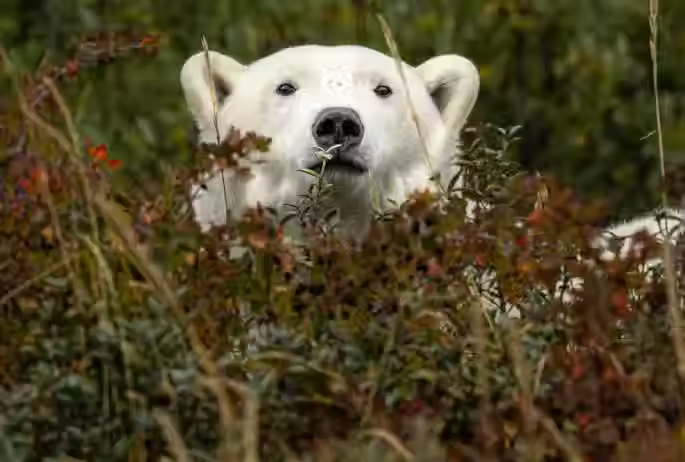
The next day the sun shines. The earth steams, the air shimmers with rising heat. All the gloom is forgotten. We had already spotted a polar bear from the observation tower, wandering westward. Along the way, we discover a second polar bear, also with its nose to the wind and heading in the same direction. A little further on, we come across a mother with two cubs.
They too are heading west. Our guides Terry, Brandon, and Hondo suspect there is a dead animal there.
"Polar bears have the best sense of smell in the animal kingdom."

Terry tells us, "You can smell a carcass from over 30 kilometers away."
After crossing several tidal creeks, we see a weathered shipwreck in the distance. Nearby, we spot three bears. Terry scans the area with his binoculars. On the bank, he discovers the suspected carcass; it's that of a beluga whale.
Every summer, approximately 55,000 to 60,000 beluga whales – the world's largest population of this species – migrate to western Hudson Bay to feed, mate, and give birth in the warm estuary of the Churchill River.

Our guides scanned the polar bears and the situation with binoculars and after a while decided that it was safe for us to approach the bears on foot.
Actually, all my primal instincts are screaming: "Don't get out, drive as far away as possible!"
The polar bear is the most dangerous of the already dangerous bears.
And what do we do? We walk to more or less cut him off!
An eerie, yet exciting feeling.
Our guides were armed with stones, blank-firing pistols, and real rifles. We trudged in a line, bundled up in the lodge's thick red clothing—hoods pulled up against the wind—like the Seven Dwarfs, heading towards the bear. We were so tense we hardly dared to breathe. Everyone was deathly silent.
We can see another polar bear approaching us along the shore of Hudson Bay. It's coming closer with surprising speed and purpose .

Although the animals seem to be walking at a leisurely pace, they're covering an astonishing distance. We hold our breath. Only a small tidal creek separates us from the polar bear.
Our guides, of course, kept us at a safe distance of over 100 meters, but given this proximity, my skin is tingling with excitement.
We can clearly see his black button eyes, which form a strong contrast to his snow-white fur.
He glances briefly in our direction, then without hesitation enters the water and swims easily to the other side. There he shakes the drops from his fur and walks purposefully towards the carcass.
A young, small female polar bear is eating when the large polar bear approaches. We expect a showdown, but the little one quickly retreats. Terry explains:
"Polar bears try to avoid any fight. Any injury can be fatal for them."

Polar bears in danger
As Alysa McCall of Polar Bears International explains, the most endangered population on Earth lives here, on the western edge of Hudson Bay: "The current figures, according to which the polar bear population is more or less constant, are misleading."
Only the number of males remains relatively constant. What is decreasing are the number of mothers with their young.
The females must build up a layer of blubber in order to give birth to their babies in winter and then stay with them in the snow cave for three to four months. They are therefore the first to suffer from food shortages. The polar ice has melted the longest here, which is why these animals will probably be the first to disappear.
"Whether that will be the case in five, 15 or perhaps even 50 years is difficult to predict, as everything is changing so quickly at the moment," she says.
Click on the first image to see the polar bears in a larger view:
A polar bear family is playing among the stones. Under observation - who is observing whom? A large male polar bear on a hike Swimming trip of the polar bear family Polar bear on Hudson Bay Several polar bears have gathered at the shipwreck because a beluga whale carcass lies there.
On the way home, we encounter the female polar bear again, whom we had already seen in the morning. This time she is sitting very close to the only path leading through the thicket. We creep closer to her little by little so as not to frighten her. She does glance up with interest now and then, but then continues eating.
Suddenly, she rears up on her hind legs and looks in our direction. She towers almost three meters high out of the bushes. She fixes her gaze on us with her jet-black button eyes before dropping back down on all fours and resuming her grazing.
Only now do I realize I was holding my breath. I got so close to a polar bear that I could look her directly in the eyes. An incredible moment.
Only a few people are fortunate enough to observe polar bears up close.
To see the Northern Lights dance
This once-in-a-lifetime moment, however, would not be the only one in Churchill. That evening, while brushing my teeth, I looked out the window and spotted a green haze that looked as if a UFO was about to land.

Excitedly, we run to the observation tower, from where we can see the structures forming and shimmering green in the sky. The activity intensifies, and I even think I can hear the air crackling.
Like in a science fiction film where aliens are trying to send us signs, huge green waves roll over us.
The sky is dancing. I'm breathless with awe.
It is an otherworldly beautiful experience that almost brings tears to my eyes.
Churchill gave me two unique experiences in just one day. A great dream of mine came true.
Information for your trip to Churchill
General information
General information on travel destinations, activities, attractions and accommodation options can be found on the Travel Manitoba website.
Arrival
Flights with a layover from Frankfurt to Winnipeg are available, for example, with Condor or Air Canada.
An electronic travel document (eTA) is required for entry into Canada.
From Winnipeg to Churchill
Churchill, the small town on Hudson Bay, can be reached by plane or, as a two-day adventure, by train . One carriage even has a glass roof for viewing the Northern Lights.

Polar bear watching with Churchill Wild
Churchill Wild is undoubtedly the most luxurious and professional operator. It's the only place where you can get up close to polar bears on foot. There are four different lodges where, depending on the season, you can also observe wolves, moose, beluga whales, black bears, and reindeer. All lodges are exclusively located in the heart of the wilderness. Only the Blueberry Lodge is located in Churchill itself.
For those who can't afford this luxury, there are other options. Depending on the time of year, you can go polar bear spotting from Churchill by tundra buggy or minibus. One provider of day tours is Discover Churchill Tours .
Beluga whales and other sights in Churchill
In July and August, you can also see beluga whales in the bay off Churchill. Unfortunately, I was too late for kayaking: these tours are only offered in July and August. However, from the Prince of Wales Fort National Historic Site, I was still able to see many of the small white whales in the water well into September.
Click on the first image to see the photos in a larger size:
The brightly painted airplane wreck Miss Piggy Beluga whales can also be seen in July and August. A short hike leads to the shipwreck of the SS Ithaca
Kayak tours are available, for example, with Sea North Tours.

Churchill Wild offers a Birds, Bears & Belugas Safari at the Seal River Heritage Lodge in July and August.
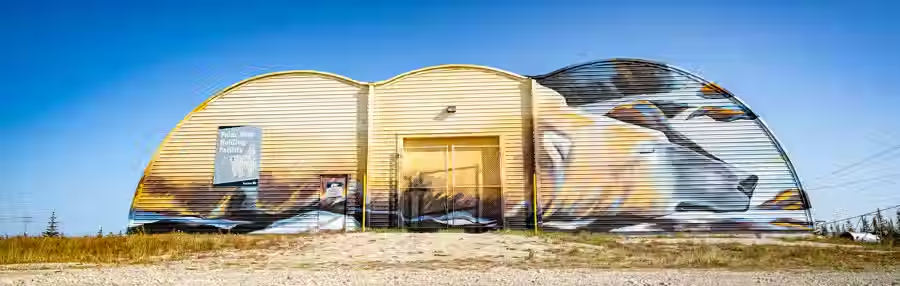
In Churchill itself there is also plenty to see, such as the polar bear prison, the Miss Piggy plane wreck , the Prince of Wales Fort National Historic Site , the Rocket Research Range , or the SS Ithaca shipwreck . Many of the buildings are decorated with cool graffiti.
Remember, whatever you do: you are in polar bear territory. No matter where you are, you could encounter one of these animals. Therefore, book a guided tour with a qualified guide, for example with Discover Churchill .


Comments